Blog
Project Conway #01 – an introduction
Project Conway is a collaborative education project between Deeson Online and the University of Kent’s TinkerSoc and School of Computing.
We’re teaming up for a few reasons, including giving students the opportunity to work with a commercial organisation, but the more juicy stuff is yet to be discovered. Which makes it particularly exciting. Why? Because even though we're not entirely sure what's going to fall from this, we know learning through experimentation is critical to discovering new ideas and trends in technology. So experiment we shall.
What are we trying to achieve?
The main objective of the project is to produce a large display panel with a series of LEDs that will show the simulation developed by John Conway called the Game of Life. This will also connect up to our Little Printer, which will print out the 'obituary' of each life cycle, triggered (in time) by members of the general public via a web interface of some kind.
But there is more to what we’ve coined ‘Project Conway’. This is about pulling together lots of different threads, including problem solving, collaboration, development, education and electronics.
So… what exactly is Conway’s Game of Life?
As student Michael Wilson explains in the video below, the Game of Life (GoL) is not a game in the usual sense – it need only be set up by a single human player who creates the initial state of the microstructure, constituting the ‘seed’ of the system.
Pay attention. Here come the GoL rules:
Conway’s GoL is actually a very simple simulation, operating by four rules:
-
Any living cell with fewer than two living neighbours will die in the next generation (as if by under-population)
-
Any living cell with more than three live neighbours will die in the next generation (as if by overcrowding)
-
Any living cell with two or three more living neighbours will live on into the next generation
-
Any dead cell with exactly three living neighbours will become living in the next generation (as if by reproduction)
Conway designed these rules to meet the following criteria:
-
There should be no explosive growth
-
There should exist initial patterns with chaotic, unpredictable outcomes
-
There should be potential for von Neumann universal constructors
-
The rules should be as simple as possible, whilst adhering to the above constraints
The first generation is then created by simultaneously applying the above rules to every cell in the seed. This means all births and deaths also occur simultaneously... and this moment is called 'the lack'. (Keeping up?).
What will it look like?
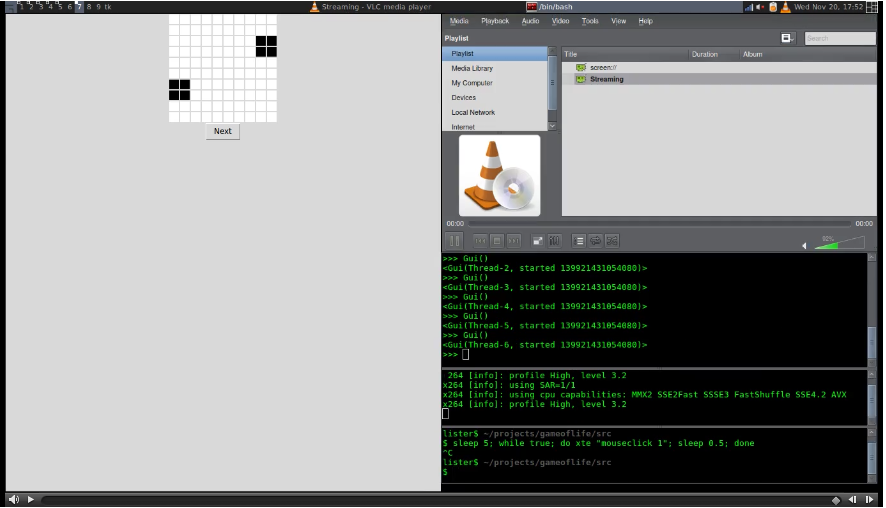
It’ll look like this, but a lot, lot bigger and shinier with more lights, and is likely going to be placed in a window much like an art installation.
How will the students, University of Kent, TinkerSoc and Deeson Online work together?
-
Instead of a dissertation, final year students at University of Kent have a group project to complete
-
Working with TinkerSoc, we’ve created a project proposal for two final-year computer science students. This project will see the development of the software that will drive the display panel, play the simulation and allow members of the general public, through a web-based interface, to interact with it
-
Academic staff will manage the students and students will be working on the project as part of their timetable
-
The students will get a final grade
-
TinkerSoc will build the hardware
-
As the ‘client’, Deeson Online impose deadlines for some deliverables, and the final product will have a real use
Why is this project of value?
In the past, Conway’s GoL has been applied to research into cellular structure, as well as being used in research into population growth and decay and, in some cases, also population movement. There are also theorists who suggest, that given enough time, space and memory, a microstructure created by GoL could come to represent artificial intelligence.
However, GoL has many more uses beyond research. For example, it could be a great platform to teach young people about programming and offers kids an engaging way into the industry. It also provides an introduction into aspects of natural science, sociology and quite possibly artificial neurology, depending on what it is being used to represent!
Moving forward
Over the coming weeks, we’ll be getting updates from the students which we'll blog about, as well as deeper project explanations (such as pfds) for you to read. Then, on 12 March, the students will present Project Conway at Digibury by way of a talk and demo. Exciting stuff! Look out for more in 2014!
Add new comment